Discover RED KOMODO-X recording options, global shutter, 6K 80fps, RAW workflows and how it differs from the original KOMODO.
The RED KOMODO-X takes the basic idea of the original KOMODO—compact cinema imaging with a Super 35 global-shutter sensor—and builds in more speed and production flexibility. If you’ve seen the two cameras mentioned together, the important question is not whether one is universally ‘better’. It’s which recording options and practical features your shoot actually needs.
For a brand commissioning video, those choices influence how slow motion is captured, how much rigging is needed and how quickly the material can move into the edit. They don’t decide the whole creative result.
What is the KOMODO-X?
The KOMODO-X is a professional 6K cinema camera from RED Digital Cinema. RED’s published guide lists a 19.9-megapixel Super 35 global-shutter CMOS sensor with an effective resolution of 6144 × 3240 pixels and a claimed dynamic range of 16.5+ stops.
It has an integrated locking RF mount, supports suitable adapters for other lens systems and records REDCODE RAW to qualified CFexpress media. Relative to the original KOMODO, the body is designed for a more demanding production workflow and faster frame rates.
The ‘X’ in the name matters. Do not assume that the original KOMODO and KOMODO-X use interchangeable media or have identical rigging requirements.
How fast can it record?
RED lists a maximum of 80fps at 6K 17:9, 120fps at 4K 17:9 and 240fps at 2K 17:9 for the KOMODO-X, subject to the relevant recording options. By contrast, the original KOMODO is specified at up to 40fps at 6K 17:9 and 60fps at 4K 17:9.
That matters when the brief includes pouring liquids, flying fabric, lively event details, machinery in motion or products moving through a scene. Shooting at a higher frame rate gives the edit the option to slow movement down while maintaining a smooth result.
But slow motion is not always the right creative choice. If every shot becomes a dramatic slow-motion sequence, a business film can lose energy or clarity. The frame rate should follow the story.
Global shutter without the usual compromises of movement
Like the original KOMODO, KOMODO-X uses a global shutter. This reduces the geometric distortion that can appear with fast movement on rolling-shutter cameras. For vehicle movement, handheld pans, busy set details and certain flashing-light environments, it offers practical advantages.
Global shutter is not a substitute for shutter-speed choices or good lighting. Those still affect motion blur and exposure. The cinematographer needs to balance the camera’s technical possibilities against the visual effect being created.
What does its compact design make possible?
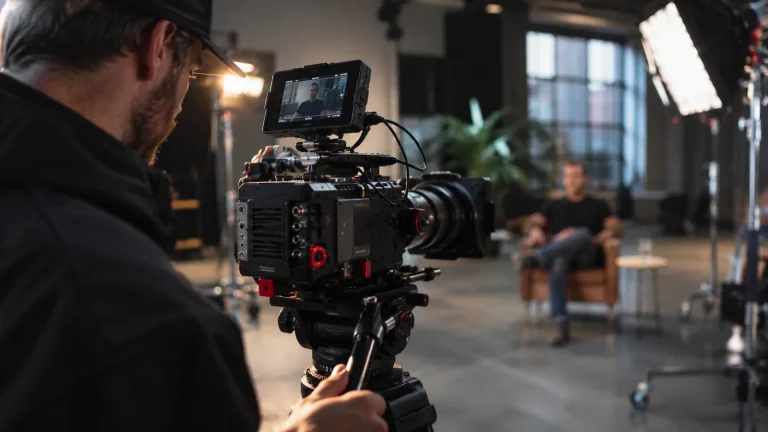
A smaller cinema body can fit into more production setups. In a busy workplace, for example, a crew might want both a controlled interview station and moving B-roll without filling the entire floor with equipment. On a product shoot, a compact setup can be easier to position beside machinery or around a tabletop.
A gimbal, car rig or lightweight support can also become more practical when the core camera is compact. However, any rig still requires the correct lens, power arrangement, weight balance, monitoring and safety checks. Never assume a small camera is suitable for a particular aerial or vehicle mount without a specialist assessment.
Why RAW recording is useful
REDCODE RAW creates flexibility in the finishing stage. A colourist can work with image data in a way that supports considered colour treatments, matching between shots and adjustments for different campaign outputs. That is especially helpful when a brand has a clear visual identity and the film needs to feel consistent from shot to shot.
The trade-off is storage and workflow. Production teams should plan media offloads, backups, proxy creation if necessary, edit approvals and final colour. A camera capable of recording excellent RAW footage still needs a sensible post-production process.
KOMODO-X versus the original KOMODO
The headline differences are speed, media and some aspects of the camera system. RED specifies 6K 80fps and CFexpress on the KOMODO-X, compared with 6K 40fps and CFast 2.0 on the original. KOMODO-X has a locking RF mount and more demanding high-data-rate capability. Both retain a Super 35 global-shutter approach.
A less expensive original KOMODO could still deliver the correct film. The added flexibility of KOMODO-X is valuable when the shot list actually uses it. Hire cost, crew familiarity and existing accessories also influence which is sensible.
Which types of videos suit KOMODO-X?
It can be a strong option for high-end corporate stories, brand films, product campaigns, automotive details, recruitment pieces and interviews where the final grade matters. It is also useful when a shoot has to produce several versions for web and social, although thoughtful composition is still necessary for vertical edits.
It is less compelling when the most important requirement is rapid turnaround, minimal equipment or a very small budget. A good videographer should feel comfortable saying that another camera system is a better fit.
What should clients ask before a KOMODO-X shoot?
Discuss the number of filming days, locations, deliverable sizes, portrait and landscape versions, required slow motion, interview audio, lighting, music licensing and colour treatment. Ask whether the quote covers a fully crewed production or only a camera operator. Camera specification alone rarely tells you what is included.
Technical sources: RED KOMODO-X specifications; original KOMODO specifications.