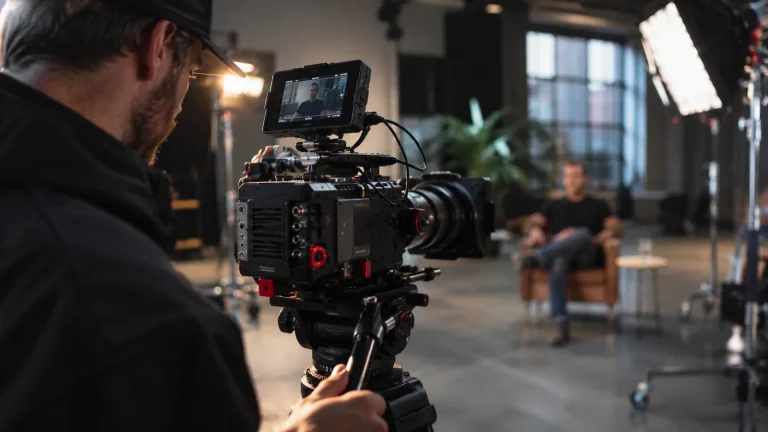
Learn what makes the RED V-RAPTOR XL different, from built-in ND and production rigging to 8K recording and practical filming uses.
Some cinema cameras are designed to be as small as possible. Others are built around the practical demands of a full production set: repeated lens changes, cinema accessories, camera assistants, controlled exposure, complex monitoring and reliable connections to the wider crew. The RED V-RAPTOR XL sits firmly in the second category.
If you’re researching the XL because you’ve seen it on a commercial set or a high-end film shoot, the key difference isn’t simply image quality. It’s the way the camera is designed to integrate into a larger production workflow.
What does ‘XL’ mean in the V-RAPTOR family?
V-RAPTOR XL is a production-oriented cinema camera system based on RED’s V-RAPTOR imaging family. Its design incorporates features that are often added externally to a compact camera, helping the camera fit more naturally into large crew setups.
There are different generations to distinguish. The V-RAPTOR XL 8K VV and V-RAPTOR XL [X] 8K VV are not identical. RED specifies a global-shutter sensor for the [X] version; the earlier XL version uses a different sensor design. Always check which model a technical article, rental quote or crew member is referring to.
What are the RED V-RAPTOR XL [X] specifications?
RED’s published guide for the V-RAPTOR XL [X] 8K VV describes a 35.4-megapixel global-shutter CMOS sensor with an effective 8192 × 4320 capture area and a claimed dynamic range of more than 17 stops. It records REDCODE RAW and offers high-frame-rate modes, with maximum options varying by resolution and recording settings.
The XL design also includes an interchangeable lens mount system, a professional power arrangement and built-in electronic neutral-density filtration. RED lists an integrated ND range from 2 to 7 stops on the XL [X] camera.
You shouldn’t infer that every V-RAPTOR camera has built-in ND. That is one reason the XL should be considered separately from the compact V-RAPTOR bodies.
Why does built-in ND matter on a film set?
Neutral-density filters reduce incoming light without requiring the cinematographer to change the desired shutter or aperture simply to control exposure. In daylight, an ND filter can allow a wider aperture while maintaining the chosen motion rendering.
On a busy production, integrated ND can make exposure changes faster and reduce how often the crew needs to swap physical filters. It is not a complete replacement for all creative filtration, but it is useful in a camera designed for demanding setups.
What is different about the XL body?
A compact camera can be assembled into a sophisticated rig, but each extra module adds complexity: power distribution, cable routing, monitoring, lens support and external filtration. The XL platform is intended to reduce some of that assembly burden.
In practice, this may suit sets with camera assistants, larger cinema lenses, wireless monitoring, professional power systems and repeated shot changes. For a one-person operator moving rapidly through a crowded office, however, a smaller camera may be much more practical.
Why use 8K on a commercial shoot?
A large-format 8K original can be useful for high-end visual work, complex composites, flexible finishing and delivering different crops from one shoot. In a product film, additional detail can help preserve texture. In a brand campaign, the grade and post workflow may be more ambitious than for a routine social clip.
But the image still depends on lenses, lighting, choreography and creative decisions. An 8K XL rig doesn’t automatically produce better storytelling, and it can increase costs that don’t benefit every client.
V-RAPTOR XL versus standard V-RAPTOR
The standard V-RAPTOR is a relatively compact cinema platform. The XL is intended for more integrated professional production. Both have related imaging capabilities within their respective generations, but the XL emphasises on-set features and configuration. Compare not only the headline sensor resolution but also filtration, mounting, power, rigging and crew needs.
If you’re hiring a production company, you don’t have to know which body is best. Describe the planned movements, locations, visual style and final deliverables, and let the crew explain what the appropriate system achieves.
Which productions suit the XL best?
The camera can make sense on controlled studio commercials, high-end brand campaigns, multi-camera sets, vehicle work with specialist rigging, visual-effects-heavy scenes and productions where crew integration matters. It is less likely to be the most economical choice for a handful of office interviews or quick social videos.
The cost is not just the camera rental or purchase. Lenses, crew, lights, grip, storage, monitoring and the edit all contribute. A well-scoped production quote should make that relationship clear.
Technical sources: V-RAPTOR XL X technical specification; original V-RAPTOR XL specification.