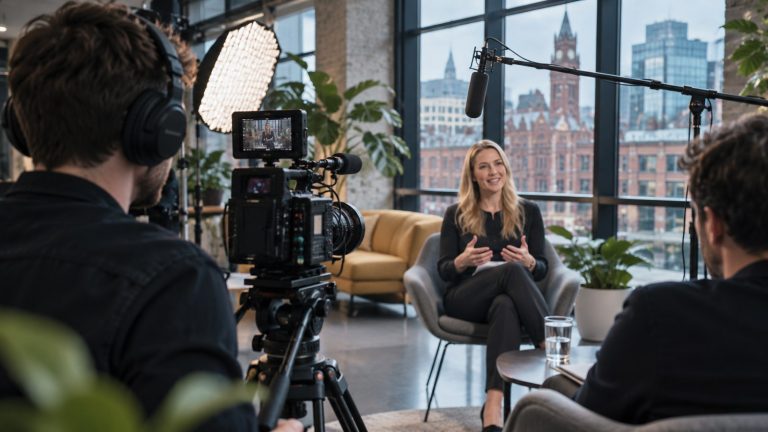
How to compare production quotes properly, without getting caught by hidden assumptions.
You’ve asked two videographers to price the same project. One comes back at £950. The other quotes £2,100. Does that mean one is charging more than twice as much for the same work?
Possibly. But first, check whether they’re actually quoting for the same work.
A useful professional videography quote should identify the filming dates and locations, preparation, crew and equipment, editing work, finished deliverables, revision rounds, delivery schedule, travel, VAT and any relevant usage rights. It should also be clear about exclusions. Once you have that information, you can judge the value rather than trying to guess from the total.
We put this guide together for the person who needs to commission the film, explain the spend internally and avoid surprises after the shoot.
1. Pre-production: what’s happening before the filming day?
‘Pre-production’ sounds grand. Often it means getting the basics right: agreeing the purpose, arranging interviews, preparing a realistic schedule and working out what the finished edit needs to contain.
A quote may include some or all of the following:
- Initial briefing and creative discussion.
- Script development or interview question planning.
- Filming schedule, shot list and location planning.
- Coordination with speakers, venue staff or stakeholders.
- Location checks, access requirements and permissions.
A simple interview shoot may only need a short call and a sensible shot plan. A campaign across four locations deserves more thought. The point isn’t to buy as much planning as possible; it’s to know who is responsible for it.
Ask: ‘Will you develop the filming plan with us, or do you need us to supply a final schedule and shot list?’
2. Filming: crew, hours and equipment
Check how the filming time is defined. Does a ‘day’ mean a fixed number of working hours? Is setup included? What happens if the event runs late? Are there additional camera operators, sound or lighting support?
A single experienced videographer can be plenty for one interview. But simultaneous sessions at a conference, several speakers moving between rooms or an ambitious brand shoot may need a different approach.
The camera model is rarely the most useful comparison. What matters is whether the equipment and crew can capture the footage and sound your project needs.
Ask: ‘Who is attending, what is the filming window and what happens if we run over?’
3. Post-production: what does ‘editing included’ mean?
Most businesses need a finished film, not a hard drive of clips. Editing may involve selecting footage, arranging the story, cleaning up audio, colour work, music, titles and exports. More complicated productions may add animation, voiceover, subtitles or graphics.
Get the editing deliverables in writing. A quote for one 90-second video is not comparable to a quote for that film plus six shorter edits and two aspect ratios.
Ask whether the proposal includes:
- Main edit and approximate duration.
- Short cutdowns or separate social edits.
- Basic colour and sound finishing.
- Titles, graphics, animation or branded end frames.
- Captions, subtitles and accessibility versions.
- Music licensing and any voiceover.
- Export formats required for website, events or social platforms.
If you want social media video content as well as a website film, decide that early. It may change the way the team shoots, not just how the editor crops the footage afterwards.
4. Revisions and client feedback
Most projects need feedback. The quote should say how many review rounds are included and whether significant changes to the agreed brief cost extra. It should also explain when the client is expected to return comments.
For a business with several approvers, the easiest improvement is to nominate one person to consolidate feedback. Sending four separate, contradictory sets of changes is a good way to spend everyone’s time without improving the film.
Ask: ‘How many rounds of revisions are included, and what counts as a change in scope?’
5. Usage rights, music and raw footage
An edited film may contain music, stock footage, voiceover, graphics or paid talent. Some of those elements carry their own licence terms, particularly for advertising or broadcast use. Check that the permitted use matches what your marketing team intends to do.
Raw footage is a separate point. Some suppliers will supply source footage under agreed terms; others don’t include it by default. If you want your own team to re-edit material later, don’t leave that conversation until after the shoot.
Copyright and licensing depend on the written agreement and the rights in the underlying material. If unrestricted use or transfer of rights is commercially important, make the terms explicit rather than assuming an invoice transfers everything.
Ask: ‘What can we publish, on which channels, and do we receive the source files?’
6. Travel, expenses, permissions and VAT
Check whether travel to the filming location is included, along with any parking, accommodation, venue charges or additional access costs. Filming in Manchester city centre and filming at three sites across the UK are obviously different logistical jobs.
Also confirm what you need to arrange. The client may need to provide access, approve filming areas, notify staff or secure permission from venue management. Responsibility should be agreed before the day.
And make sure the quoted figure makes the VAT position clear. An unclear tax line can make two totals look more different than they are.
How two quotes can look different but offer different value
Here’s a fictional comparison to show how to read a quote; these are not Videographer Manchester rates or actual supplier proposals.
| Item | Quote A: £1,050 | Quote B: £1,850 |
|---|---|---|
| Filming | One operator, one day | One operator, one day |
| Planning | Client provides shot list | Briefing call and planned shot list |
| Editing | One main video | One main video and two shorter versions |
| Captions | Not included | Included for the specified files |
| Revisions | One round | Two rounds |
| Travel | Charged separately | Included for agreed location |
| Usage | Not specified | Finished-film usage described |
| VAT | Needs checking | Needs checking |
Quote A could be a great deal if you already have a plan and only need the main edit. Quote B might be better value if your marketing team needs multiple versions and production support.
The winner depends on what your business actually needs. If a quote doesn’t say, ask. Don’t assume an omission means an item is free or unavailable.
What a clear videography quote could look like
For a fairly contained corporate interview shoot, a useful scope summary might read like this:
Project: Business introduction and two short interview clips. Location: One office in Manchester. Preparation: One planning call and agreed interview prompts. Filming: One crew setup, up to one scheduled filming day, with camera, lighting and audio. Editing: One 90-second landscape film plus two short vertical edits, each with agreed captions. Review: Two feedback rounds. Delivery: First edit and final files by agreed dates. Exclusions/terms: Any additional filming, significant animation, raw footage supply, travel outside the agreed area and music or talent licences subject to written terms. Fee: To be quoted based on final scope, with VAT clearly stated.
That’s not a recommendation that every video should have these deliverables. It’s a demonstration of the amount of detail that prevents misunderstandings.
Five ways to make your quote easier to compare
1. Send the same brief to every supplier
If one videographer is told the film is for a homepage and the other is told it’s for a paid campaign with four social versions, you’re not running a fair comparison. Use our video brief template to send consistent information.
2. Separate essentials from nice-to-haves
One polished hero film may be essential; a drone shot may not be. When the budget is tight, ask the producer what to protect and what to simplify. Don’t automatically cut planning or sound just because you can’t immediately see them in the finished film.
3. Make the filming date and delivery date clear
The date you need the video live is as important as the date you want the crew there. Internal review rounds, sign-off and any specialist editing need room in the schedule.
4. Check the complete final file list
Don’t rely on ‘social edits’ or ‘multiple formats’. Write down the number, lengths and aspect ratios you want. If the producer recommends something different, that’s part of a useful discussion.
5. Ask what the supplier would change
A good producer should be able to explain which parts of your idea add time or expense and what could achieve the same objective more simply. You’re paying for judgement as well as production.